If someone showed you a photograph of the Désert de Platé without telling you where it was, France would probably not be the first place that came to mind.
You might think of Iceland, the Dolomites, or even a rocky landscape somewhere in the American Southwest. Almost certainly not the French Alps.
But hidden high above the French Alps, just outside the mountain resort of Flaine, lies a place that feels almost impossible. Instead of the green alpine meadows, forests and waterfalls that many visitors imagine when they think of the Alps, you find yourself standing on an enormous expanse of pale limestone rock.
 |
| The vast limestone landscape of the Désert de Platé contrasts beautifully with the snow-covered summit of Mont Blanc. |
A world of cracks, grooves and strange stone formations stretches out in every direction. A true mountain desert.
This is the Désert de Platé, one of the most remarkable natural landscapes in Europe and one of the most unique places we have ever walked through.
Before visiting Flaine, we had seen pictures of this strange plateau. They looked impressive, but photographs cannot really capture the feeling of standing here. They can't show how vast the plateau really is, how the sunlight reflects off the white limestone, or how often you stop walking simply because you're trying to take it all in.
And then, when you turn around and see the immense peaks of the French Alps rising above the horizon, with the magnificent silhouette of Mont Blanc dominating the view, the experience becomes unforgettable.
Désert de Platé at a glance
- Location: Flaine, Haute-Savoie, French Alps
- Landscape: One of the largest limestone pavements in Europe
- Best season: summer and early autumn
- Difficulty: moderate because of uneven limestone terrain
- Highlight: incredible views of Mont Blanc
Walking Across an Ancient Seabed
As impressive as the landscape is, its history is even more remarkable.
Standing on the plateau, it's easy to assume you're simply looking at another part of the Alps. In reality, the rock beneath your feet has a story that began hundreds of millions of years before Mont Blanc even existed.
Long before these mountains were pushed into the sky, this region lay beneath a warm tropical sea. Over countless generations, shells, corals and tiny marine organisms settled on the seabed. Slowly, layer upon layer built up, eventually forming thick beds of limestone.
Millions of years later, the collision between the African and European tectonic plates changed everything. The seabed was forced upwards, folded and lifted until it became part of the mountain range we now know as the Alps.
It's a strange thought when you're standing there. You're looking at the highest mountain in Western Europe while standing on what was once the floor of an ancient ocean.
Once you realise that, the landscape becomes much more than a collection of unusual rocks. Every step is across a surface that has witnessed an almost unimaginable span of geological history.
If you look closely, you may even notice small fossils embedded in the limestone, subtle reminders that this barren plateau was once alive with marine life.
 |
| Looking across Europe's remarkable limestone plateau towards the rugged mountain scenery surrounding Flaine. |
Why Does the Désert de Platé Look Like a Desert?
Despite its name, don't expect sand dunes or scorching heat. The word désert refers to the lack of vegetation rather than the climate.
Once you reach the plateau, you'll quickly notice how little grows here. The limestone is exposed over a huge area, leaving only occasional pockets where grasses, alpine flowers and hardy mountain plants have managed to establish themselves. Compared with the green meadows lower down, the difference is striking.
The effect is almost lunar.
Grey and white rock stretches towards the horizon, broken only by deep fissures, scattered boulders and, in the distance, the jagged outline of the Alps.
It doesn't take much imagination to understand why early visitors described it as a desert.
The plateau covers roughly 2,000 hectares and is considered one of the largest limestone pavements in Europe. Numbers alone don't really prepare you for the scale. Once you're in the middle of it, the limestone seems to continue in every direction, and it's surprisingly difficult to judge just how far the plateau extends.
Unlike a sandy desert, however, this landscape is still evolving. Every rainfall, every snowfall and every winter freeze leaves its mark on the rock. The Désert de Platé isn't a frozen landscape from the past. It is still being shaped today.
 |
| Thousands of years of erosion have sculpted the limestone into fascinating rock formations. |
A beautiful landscape that demands attention
The Désert de Platé may look like an endless open plateau, but walking across it quickly teaches you that this is not a normal hiking trail.
The beauty of this place comes with a small warning: the ground beneath your feet is far more complex than it first appears.
The limestone pavement was shaped over thousands of years by erosion. Between the large slabs of rock are countless grooves, holes and deep cracks known as lapiaz. Some are clearly visible, while others can almost disappear depending on the light and the direction from which you approach them.
During our walk, we often found ourselves looking down before taking the next step. It is easy to forget where you are because the views are so impressive. One moment you are looking towards the dramatic peaks of the Alps, the next you are stopping to photograph Mont Blanc, and suddenly you realise that the rocky surface requires your full attention.
Good hiking shoes are not just recommended here; they make a real difference. The uneven limestone can be slippery, especially after rain, and the open nature of the plateau means there is little room for careless walking.
However, these natural cracks are not something that should discourage visitors. They are part of what makes the Désert de Platé unique.
This is not a landscape that has been made easy for tourists. It is a wild mountain environment where nature has shaped every metre of the terrain. And that is exactly why walking here feels so special.
 |
| The famous lapiaz patterns are one of the defining features of the Désert de Platé landscape. |
Wildlife of the Désert de Platé: animals living among the rocks
At first sight, the Désert de Platé appears almost empty. The pale limestone stretches in every direction, and compared with the green alpine meadows below, the plateau looks like a harsh and silent place.
But this first impression is misleading.
The rocks and cliffs around the Désert de Platé are home to some of the most iconic animals of the French Alps. We unfortunately did not spot any wildlife during our visit, but knowing these animals live among the cliffs made the landscape feel even more alive.
One of the most impressive residents is the alpine ibex (bouquetin des Alpes). These mountain goats are perfectly adapted to this difficult terrain. Their strong legs and remarkable balance allow them to climb across steep rocky slopes that seem impossible for most animals.
The surrounding cliffs are also a habitat for chamois, another famous Alpine species. These elegant animals are extremely agile and can often be found on steep slopes where they blend almost perfectly into the mountain scenery.
And then there are the alpine marmots, probably the animals many hikers hope to encounter. Their whistles are one of the typical sounds of the Alps, although spotting them requires some patience. They spend much of their time near their underground burrows, especially when danger is nearby.
Wildlife sightings are never guaranteed in the mountains, but that is part of the charm. Every turn of the path brings the possibility of seeing something unexpected.
Even without seeing these animals ourselves, the knowledge that ibex, chamois and marmots were somewhere among these rocks added another layer to the adventure.
The incredible contrast between the Désert de Platé and Mont Blanc
The Désert de Platé is not only special because of its unusual limestone terrain. What makes it truly unforgettable is the contrast.
Standing on the plateau, you are surrounded by a landscape that almost feels lunar: grey rocks, strange formations and an endless surface shaped by nature.
Then you look at the horizon, and there is Mont Blanc.
The highest mountain in Western Europe dominates the horizon, with its snow-covered summit and glaciers creating a dramatic contrast with the pale limestone beneath your feet.
During our walk, the scenery constantly competed for our attention. Sometimes the unusual rock formations made us stop and look down. A few minutes later, we were turning around again to admire the mountain panorama behind us. It creates a strange feeling of scale.
You are standing on a piece of Earth's history, surrounded by rocks that have existed for millions of years, while some of Europe's highest peaks rise in front of you. It is one of those moments where you simply stop walking and take it all in.
 |
| One of the highlights of the walk is the breathtaking panorama of Mont Blanc dominating the horizon. |
How to reach the Désert de Platé from Flaine
One of the things that makes the Désert de Platé so special is that this extraordinary landscape is surprisingly easy to reach.
The most convenient starting point is Flaine, a mountain resort in Haute-Savoie that is mainly known as a winter ski destination. In summer, however, the slopes around the resort transform into a paradise for hikers and nature lovers.
For our visit, we chose the cable car from Flaine to gain altitude before starting our walk. Even before reaching the plateau, the journey itself already felt like part of the adventure.
The ride up is calm and relaxing, with beautiful views over Flaine and the surrounding mountains. Looking down, you can see the resort becoming smaller while the Alpine scenery slowly opens up around you.
What makes the ride especially impressive is how clearly the landscape changes as you climb higher.
At the beginning, the view is dominated by green mountain slopes, grass and patches of forest. It looks like the classic Alpine landscape many visitors imagine: peaceful meadows surrounded by mountains.
But the higher the cable car takes you, the more the scenery starts to change. The trees become fewer. The green slopes slowly disappear. The soft mountain landscape is replaced by a much more rugged world of grey rocks and limestone.
Within a short time, you go from a typical Alpine environment to the unusual rocky landscape that makes the Désert de Platé so unique.
That transition is one of the most memorable parts of the visit. You watch the Alps transform in front of your eyes.
 |
| The cable car offers one of the easiest ways to reach the extraordinary landscape of the Désert de Platé. |
Hiking to the Désert de Platé from Flaine
For those who prefer a more active approach, it is also possible to hike up to the Désert de Platé from Flaine instead of taking the cable car.
This option requires more time and effort, but it offers a completely different experience. The route allows hikers to experience the gradual change in scenery on foot, starting among green Alpine vegetation before reaching the exposed limestone plateau.
The advantage of walking all the way is that you experience the full transition between two worlds: the lush mountain slopes below and the ancient rocky landscape above.
For experienced hikers, reaching the plateau on foot can make the arrival even more rewarding.
How difficult is the walk?
The walk itself is not extremely demanding in terms of distance or steep climbs. The biggest challenge is the terrain. The famous limestone pavement is not a smooth mountain path but a natural surface shaped by thousands of years of erosion. Deep grooves, cracks and uneven rocks mean that every step requires a little more attention than on a normal hiking trail.
There is also a walking path through the area that leads towards a small mountain bistro, where you can stop for refreshments or something to eat while enjoying the spectacular surroundings. This section is easier than walking directly across the limestone pavement, but it is still a mountain trail with small rocks and uneven sections. Some parts can be slippery.
During our visit, we saw someone unfortunately sprain their ankle on this path and struggle with the walk back. It was a good reminder that, despite its accessible appearance, the Désert de Platé is still a natural mountain environment where proper footwear and careful walking are important.
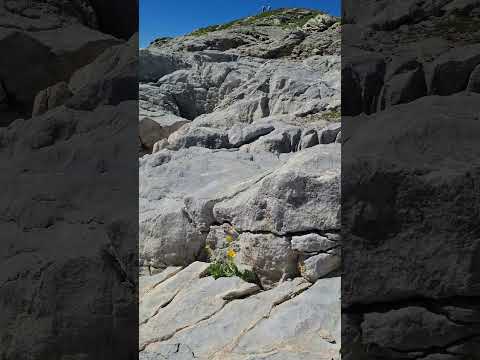 |
| Walking across the vast limestone landscape of Désert de Platé near Flaine, with the French Alps and Mont Blanc creating an unforgettable backdrop. Click to watch. |
What should you bring?
A visit to the Désert de Platé does not require technical climbing equipment, but being prepared makes the experience much more enjoyable.
Good hiking shoes are essential. The sharp and uneven limestone can be uncomfortable and slippery in normal trainers, especially after rain.
Bring enough water, as there are limited facilities once you leave the resort area. A small backpack with snacks or a picnic is also a great idea, because the plateau offers some unforgettable places to stop and enjoy the views.
A camera is almost impossible to leave behind. The combination of unusual rock formations, alpine flowers growing between the cracks and the Mont Blanc panorama creates endless photo opportunities.
Binoculars can also be useful. The cliffs around the plateau are home to Alpine wildlife such as ibex and chamois, although sightings are never guaranteed.
And don't forget a light jacket. Even in summer, the exposed plateau can feel much cooler when the wind picks up.
Can you visit the Désert de Platé with children?
Yes, but it depends on the age of your children and the route you choose.
The landscape itself is fascinating for children because it feels like stepping onto another planet. The unusual rocks, fossils and enormous views can make the walk much more exciting than a normal mountain trail.
However, parents should be aware that the plateau is not a typical easy walking path. The limestone contains deep cracks and uneven sections, and some areas require extra attention. Young children should always be supervised closely, especially near exposed sections.
For families with older children who enjoy walking and exploring, the Désert de Platé can be a truly memorable adventure. We visited with our older children, and for them, this unusual landscape quickly became one big natural playground. Instead of seeing just a rocky plateau, they were fascinated by the strange shapes of the limestone, looking closely at the stones and carefully jumping from one rock section to another as they explored the landscape.
It is a place where nature becomes a giant outdoor classroom, combining geology, wildlife and spectacular mountain scenery. The ancient fossils hidden in the limestone, the unusual rock formations and the feeling of walking through a landscape unlike anywhere else make the experience much more than just a mountain walk.
 |
| Walking across the Désert de Platé feels like exploring a completely different world high above the Alps. |
Why the Désert de Platé stays with you
Standing on the Désert de Platé, it is easy to understand why this place leaves such a strong impression. It is not just the incredible views of Mont Blanc, the unusual limestone formations, or the feeling of walking through a landscape that seems almost unreal. It is the combination of all these things.
What makes this place special is the contrast. The peaceful ride up from Flaine, the familiar green Alpine scenery slowly changing into a world of bare rock, and finally the silence of the plateau surrounded by some of the highest peaks in Europe.
We came here expecting beautiful mountain views, but we discovered something much more unique: a landscape that feels completely different from anywhere else in the Alps.
The Désert de Platé is not a place where you simply arrive, take a few photos and leave. It is a place where you slow down, look around, and realise how powerful and impressive nature can be.
It's amazing how a place can look so harsh and so beautiful at the same time. The endless limestone, tiny alpine flowers, and the view of Mont Blanc somehow all belong together.
ReplyDelete