Just outside Genoa’s historic centre, beside the impressive Porta Soprana, stands a small stone building with a connection to one of the most famous explorers in history.
This is the Christopher Columbus House in Genoa, traditionally associated with the childhood of Christopher Columbus. But there is an important detail that makes this place more interesting: historians have debated exactly how closely the surviving building corresponds to the house where Columbus lived.
So, was this really Christopher Columbus’ childhood home? Where is it, can you go inside, and is it worth visiting when you are exploring Genoa?
Here is what you should know before visiting the Columbus House in Genoa.
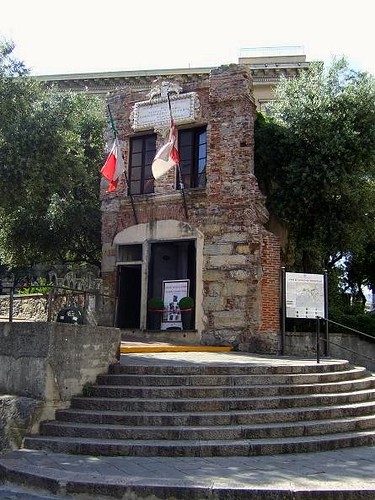 |
| The Christopher Columbus House in Genoa, near the historic Porta Soprana. |
Where Is the Christopher Columbus House in Genoa?
The Christopher Columbus House is located in the historic centre of Genoa, Italy, just beside Porta Soprana and close to the remains of the medieval city walls.
This is one of the reasons the house is so easy to include in a visit to Genoa. You do not need to make a special trip across the city to find it. It is located close to several of the city’s important historic sights and can easily be combined with a walk through the old town.
From the area around Porta Soprana, the house is particularly easy to spot because of its modest stone appearance. Compared with Genoa’s grand palaces and churches, it looks surprisingly ordinary.
Is This Really Christopher Columbus’ Childhood Home?
This is probably the most interesting question about the Columbus House in Genoa.
Genoa is traditionally recognised as the birthplace of Christopher Columbus, who was born in the city in the 15th century. The Columbus family was associated with this part of Genoa, and the building is traditionally identified as the house where the young Columbus lived.
However, it is important not to present the building as an unquestionable, perfectly preserved childhood home.
The surviving structure has a complicated history, and historians have debated the exact relationship between the present building and Columbus’ original home. The house was also reconstructed after damage over the centuries.
So while the site is strongly connected with Columbus and his Genoese origins, it is more accurate to say that the building is traditionally associated with his childhood home rather than claiming that every stone you see today definitely belonged to the house in which he grew up.
For visitors, that uncertainty actually makes the site more intriguing. You are standing in a place that has been connected with the Columbus family for centuries, while also seeing how difficult it can be to separate historical evidence from later tradition.
What Does the Columbus House Look Like?
The Columbus House is very different from the grand historic buildings you might expect to find in Genoa.
It is a relatively small stone building with a simple medieval appearance. There is no enormous entrance, elaborate marble decoration or palace-like courtyard. Instead, the house gives you an impression of what a much more modest part of historic Genoa looked like.
Its location is particularly interesting. The house stands close to Porta Soprana, one of the best-known surviving gateways of medieval Genoa. Walking around this area makes it easier to imagine how different the city would have looked during Columbus’ childhood.
Can You Go Inside the Christopher Columbus House?
The Columbus House is a small historic attraction beside Porta Soprana. If you can go inside depends on the current opening arrangements, so it is worth checking the latest visitor information before planning your visit.
The attraction is small, so do not expect a huge museum complex. The main appeal is the combination of the building itself, its historical connection with Columbus and its location in one of the most interesting parts of Genoa.
For many visitors, the outside of the building is already worth seeing because you can combine it with Porta Soprana and the surrounding historic streets.
What Can You See at the Columbus House?
The Columbus House is not the kind of attraction where you need several hours to see everything.
Instead, the experience is focused on the building and its connection with Christopher Columbus and Genoa’s history.
Depending on the current access and exhibitions, visitors can learn more about:
- Christopher Columbus and his connection with Genoa
- The Columbus family
- Life in medieval and Renaissance Genoa
- The city’s maritime history
- Columbus’ early life before his famous voyages
The most interesting part for me is not the size of the attraction but the story behind it.
It is easy to think of Columbus only in connection with his later voyages across the Atlantic. Standing at a site associated with his early years gives you a different perspective: before the ships, voyages and historical fame, he was simply a young man growing up in Genoa.
How Long Does It Take to Visit the Columbus House?
You do not need to set aside half a day for the Christopher Columbus House.
If you are visiting the house itself, a short visit is enough for most travellers. The real advantage is that it can easily be combined with other attractions in the area.
I would recommend treating the Columbus House as part of a Genoa walking route rather than travelling across the city specifically for this one small attraction.
You can combine it with Porta Soprana, the historic centre and other nearby sights, turning a quick stop into part of a much more interesting walk through Genoa.
Christopher Columbus House and Porta Soprana
One of the best things about visiting the Columbus House is its location.
Porta Soprana is one of Genoa’s most recognisable medieval landmarks and stands almost immediately beside the Columbus House. The two sights work extremely well together.
Porta Soprana gives you an idea of Genoa’s medieval fortifications, while the Columbus House provides a personal connection to one of the city’s most famous historical figures.
If you are exploring Genoa on foot, you can easily stop at both without needing to make a separate journey.
Why Is Christopher Columbus Important to Genoa?
Christopher Columbus remains one of the most famous figures associated with Genoa.
The city has long celebrated its connection with the explorer, and reminders of Columbus can be found throughout Genoa.
His connection with the city is particularly interesting because Genoa was one of the great maritime centres of Europe. Its location on the Mediterranean helped make it an important centre of trade, shipping and commerce.
Columbus’ early life therefore makes sense within the wider story of Genoa as a maritime city.
Visiting the house gives you a small piece of that story before moving on to the much larger sights of the city.
Is the Columbus House the Birthplace of Christopher Columbus?
This is another point worth clarifying.
Genoa is traditionally regarded as Christopher Columbus’ birthplace, but the exact location of his birth is not something that should automatically be equated with the surviving Columbus House.
The house is primarily associated with his family and childhood rather than being presented as a perfectly preserved birthplace.
That distinction is important because you will sometimes see the attraction described simply as the “birthplace of Christopher Columbus” or the “home of Columbus.” The historical story is more complicated.
If you are interested in Columbus, however, this is still one of the most relevant places to visit in Genoa.
How to Get to Christopher Columbus’ House
The Columbus House is in a central part of Genoa and is best visited on foot when exploring the historic centre.
Its location close to Porta Soprana makes it particularly convenient for visitors already exploring the old town.
Rather than planning an entire trip around the house, I would include it as one stop on a walking itinerary through central Genoa.
That way, you can see the house, Porta Soprana and several other historic sights in the same part of the city.
Is the Christopher Columbus House Worth Visiting?
Yes, if you are interested in history or are already exploring Genoa’s historic centre.
The Columbus House is not a huge attraction and it does not have the scale of Genoa’s major palaces, museums or churches. But that is not really the point.
Its appeal comes from the story.
You are standing beside Porta Soprana, in one of the oldest parts of Genoa, at a site traditionally associated with the early life of a man who would later become one of the most famous explorers in history.
It is also a very easy attraction to add to a day in Genoa. You do not need to spend hours here, and its central location means you can combine it with several other sights.
A Small House With a Huge Connection to History
The Christopher Columbus House may look modest compared with the spectacular palaces and churches of Genoa, but its historical connection gives it an importance far beyond its size.
If you see the building as the exact childhood home of Columbus or as a place traditionally connected with his family and early life, it offers an unusual glimpse into the world behind the famous explorer.
Before Christopher Columbus became the explorer known around the world, there was Genoa. There were these narrow streets, the medieval city walls, the harbour and the ordinary buildings where people lived their daily lives.
The Columbus House gives you a small connection to that earlier story.
So when you visit Genoa and walk through Porta Soprana, take a moment to look for this unassuming stone building. It may only take a few minutes to see, but it connects one of Italy’s great historic cities with one of the most famous names in world history.