Le Tréport had been on our horizon long before we ever set foot there.
During our stay in nearby Mers-les-Bains, it was always visible in the distance, a coastal town sitting quietly beneath the white chalk cliffs. Whether we were walking along the seafront, sitting on the beach, or simply looking south along the coast, that backdrop never really disappeared.
After a few days, curiosity got the better of us. We wanted to see what lay beneath it all. So one day, we set off for Le Tréport.
 |
| Looking down over Le Tréport from the clifftop, with neighbouring Mers-les-Bains visible along the coastline in the distance. |
As we approached, the scale of the landscape slowly revealed itself. What had looked distant and almost delicate from across the bay became far more imposing up close, shaping the town in a way that felt unlike anywhere else we had visited during our time in the Baie de Somme.
Naturally, that was where we started our visit.
Taking the Funicular to the Top
One of the nicest things about Le Tréport is that reaching the top of the cliffs requires almost no effort.
A free funicular connects the lower town with the clifftop in just a few minutes. The journey is so short that by the time people have turned around to admire the view behind them, the doors are already opening again.
 |
| The free funicular provides an easy journey between the lower town and the scenic viewpoints above. |
At the top, Le Tréport suddenly feels smaller.
The harbour becomes a collection of neat lines and tiny boats. Streets that seemed busy a few minutes earlier become difficult to distinguish from one another. Beyond it all sits the English Channel, stretching towards a horizon that appears much further away than it did from sea level.
Many visitors ride the funicular, take a few photos, and head back down. We decided to stay a little longer.
Walking along the clifftop paths offers even better views of the coastline. The white chalk cliffs stretch away into the distance, while the sea seems endless on the horizon. It's the kind of scenery that makes you stop every few minutes simply to take it all in.
Descending Into the Old Town
Rather than taking the funicular back down, we chose the staircase. The route follows 365 steps, connecting the upper town with the seafront below.
The walk back into town provides a completely different perspective and gradually leads you into the historic heart of Le Tréport.
Before long, the wide-open views of the cliffs are replaced by narrow streets, old buildings, and quiet corners that feel far removed from the busy waterfront.
 |
| The Hôtel de Calais is one of the characterful historic buildings found while exploring the older streets of Le Tréport. |
This older part of town has plenty of character and is worth exploring at a slower pace.
At one point we hoped to visit the church, but found the doors closed.
Normally that might have been disappointing. Instead, it simply became another excuse to keep walking.
Life Around the Harbour
Eventually we arrived at the harbour.
What struck me most wasn’t just the boats, but the atmosphere settling over everything.
This is where Le Tréport becomes especially inviting. Along the waterfront, seafood restaurants line the quays, offering plates of fresh “fruit de mer” to anyone settling in for a long, unhurried lunch. Nearby, people sit out on the terraces with drinks in hand, watching the harbour life drift by rather than rushing through it.
There’s also a constant mix of small, everyday pleasures: the smell of crêpes being made fresh nearby, drifting out from stalls and cafés; the sound of cutlery and glasses from the restaurants; and the quiet movement of people wandering between souvenir shops.
We ended up buying ice cream and doing very little for a while.
Travel guides rarely recommend moments like that, but they’re often the parts of a day that stay with you longest.
An Unexpected Carnival
One thing we hadn't expected was the carnival taking place during our visit.
The fairground rides and attractions added an extra layer of excitement to the town, particularly for families travelling with children.
The atmosphere felt festive and lively, with music, lights, and plenty of activity around the waterfront.
While the carnival won't be there year-round, it certainly made our visit even more memorable and gave the kids an extra reason to enjoy the day.
Had we visited a week earlier or later, it wouldn't have been there at all.
That's one of the things I enjoy about travel. Sometimes the places you visit aren't the only thing shaping the day. Sometimes timing does part of the work for you.
Walking Towards the Lighthouse
From the harbour, we continued towards the lighthouse at the end of the western breakwater. The walk itself is part of the experience, gradually pulling you away from the busy waterfront and out towards the open sea.
 |
| Standing at the end of the breakwater, the lighthouse marks the entrance to the harbour and offers wide coastal views. |
Standing near the lighthouse, we were treated to one of the best panoramas of the day. Looking back towards Le Tréport, the towering white cliffs seemed even more impressive than they had from the town itself. Their sheer scale dominates the coastline and creates one of the most dramatic landscapes in northern France.
 |
| From the lighthouse, the white chalk cliffs and pebble beach reveal the dramatic landscape that defines this stretch of coast. |
Below, the pebble beach stretched along the shoreline, while in the distance we could clearly see the elegant seafront of Mers-les-Bains. From this vantage point, it becomes easy to appreciate how closely connected these two coastal towns are.
If you're visiting Le Tréport, don't stop at the harbour. The short walk to the lighthouse rewards you with some of the finest views of the cliffs, the beach, and the surrounding coastline.
The Walk Between Two Seaside Towns
One thing many visitors don't realise is how easy it is to combine Le Tréport with neighbouring Mers-les-Bains.
"Easy" doesn't mean they're right next to each other.
The walk takes around 25 minutes, which is just enough time to feel like you've actually travelled somewhere rather than simply crossed a street.
Along the way, you pass the lock system connecting the harbour and canal waters. It's not a major attraction that appears on postcards, but it adds an interesting transition between the two towns.
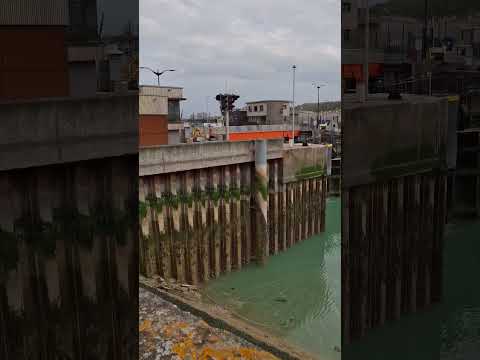 |
| Walking from Mers-les-Bains to Le Tréport offers a unique coastal experience. Click to watch. |
If you're exploring the Baie de Somme, don't overlook Le Tréport and Mers-les-Bains. Together they make a perfect full-day outing, with enough variety to fill half a day in each town without ever feeling rushed.
Why Le Tréport Stayed With Us
Le Tréport could easily have been a town defined by a single attraction. Many places with scenery this dramatic rely entirely on it. Yet what stayed with me wasn't just the cliffs.
It was how often the day seemed to change character.
.jpg "A Glimpse of the Medieval Past") |
| The former city gate stands as a reminder of Le Tréport's long history and its importance as a coastal settlement. |
A clifftop viewpoint became a staircase into the old town. The old town became a harbour. The harbour became a carnival. The carnival gave way to a quiet walk towards the lighthouse.
Every few hours felt like a different chapter.
The cliffs may have been what first caught our attention. But it was everything happening beneath them that made us glad we stayed.
It’s funny how a place can feel completely different once you’ve actually walked through it rather than just seen it from a distance.
ReplyDelete